

PEEK Material Overview: Properties, Grades, Applications, and Extruded Shapes
What Is PEEK?
Polyetheretherketone (PEEK) is one of the most widely used materials within the polyaryletherketone (PAEK) family of high-performance thermoplastics. Since its commercial introduction in the early 1980s, PEEK has become a preferred engineering material for demanding applications in the aerospace, oil and gas, semiconductor, medical, automotive, electronics, and chemical processing industries.
PEEK is often selected when performance is more important than material cost. It combines exceptional mechanical strength, chemical resistance, dimensional stability, and high-temperature performance with the ability to be melt processed using conventional thermoplastic manufacturing methods such as extrusion and injection molding.
Compared to lower-performance engineering plastics, PEEK maintains its properties at significantly higher temperatures while offering excellent resistance to aggressive chemicals, steam, and hydrolysis. It is also frequently specified as a stronger alternative to fluoropolymers such as PTFE, PVDF, and PCTFE in applications requiring improved structural performance.

Key Properties of PEEK
High Temperature Resistance
One of PEEK’s defining characteristics is its ability to operate continuously at elevated temperatures. With a glass transition temperature (Tg) near 300°F and a melting temperature around 650°F, PEEK performs well beyond the limits of many traditional engineering plastics.
Tg~300º
This high thermal capability allows PEEK components to maintain strength and dimensional stability in environments involving hot fluids, steam sterilization, or continuous thermal cycling.
Excellent Chemical Resistance
PEEK demonstrates outstanding resistance to a broad range of chemicals including:
Hydrocarbons
Organic solvents
Acids and bases
Hot water and steam
Automotive and aerospace fluids
This chemical resistance makes PEEK suitable for aggressive operating environments where many engineering plastics would degrade or swell.
Mechanical Strength and Wear Resistance
PEEK offers an exceptional balance of:
Tensile strength
Stiffness
Impact resistance
Fatigue resistance
Creep resistance
Wear performance
Reinforced and bearing grades further improve stiffness, dimensional stability, and tribological performance for dynamic applications such as bushings, seals, thrust washers, and compressor components.
Processing and Manufacturing of PEEK Shapes
PEEK can be processed using several manufacturing methods including:
Extrusion
Injection molding
Compression molding
Thermoforming
Machining from stock shapes
Because of its high processing temperatures, specialized extrusion and molding equipment is typically required to achieve optimal material performance and minimize resin degradation.
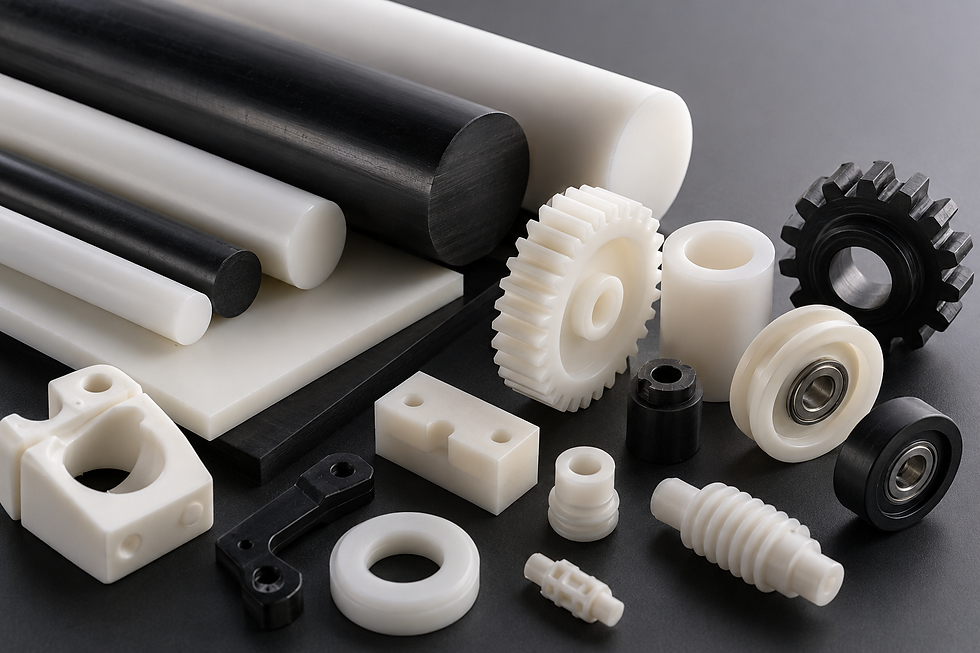
For machinable plastic applications, PEEK is commonly supplied in stock shapes such as:
Rod
Plate
Sheet
Tube
Custom extruded profiles
Custom extruded PEEK shapes can significantly improve machining yield and reduce material waste compared to machining from oversized stock forms.
Growth of the PEEK Market
The global demand for PEEK continues to grow as industries seek lighter, stronger, and more chemically resistant alternatives to metals and conventional plastics. Over the past decade, annual growth rates for PEEK materials have generally been estimated in the 6–8% range.
Applications involving electrification, semiconductor manufacturing, medical devices, aerospace lightweighting, and industrial automation continue to drive increased use of PEEK-based materials worldwide.
Understanding PEEK Resin Grades
Although many manufacturers market proprietary trade names for extruded shapes and semi-finished stock, the underlying polymer chemistry remains fundamentally the same.
All PEEK materials are based on polyetheretherketone chemistry, and the baseline properties are primarily determined by the resin itself. The quality of the final shape or molded component depends heavily on proper processing techniques that preserve the inherent properties of the polymer.
Poor processing conditions can negatively affect mechanical properties, dimensional stability, color consistency, and long-term performance.
Major PEEK Resin Manufacturers
Today, most commercial PEEK resins are supplied by:
Victrex
Syensqo (formerly Solvay)
Evonik
These suppliers produce unfilled, reinforced, wear-resistant, and specialty PEEK compounds for demanding engineering applications.Additional manufacturers, including emerging suppliers in Asia, continue to enter the market as global demand increases.
Common PEEK Resin Grades
Victrex PEEK Grades
Victrex 150G — Low viscosity grade primarily used for injection molding
Victrex 450G — High viscosity grade commonly used for extrusion and thick-wall parts
Victrex 450GL30 — 30% glass fiber reinforced
Victrex 450CA30 — 30% carbon fiber reinforced
Victrex 450FC30 — Bearing grade with carbon fiber, graphite, and PTFE additives
Victrex HT — Higher temperature PEK-based material
Syensqo Ketaspire PEEK Grades
Ketaspire KT-880 — Low viscosity injection molding grade
Ketaspire KT-820 — High viscosity extrusion grade
Ketaspire KT-820 GF30 — Glass fiber reinforced
Ketaspire KT-820 CF30 — Carbon fiber reinforced
Ketaspire KT-820 SL30 — Wear-resistant bearing grade
Ketaspire PEEK XT — Higher temperature PEEK formulation
Evonik Vestakeep Grades
Vestakeep 1000–3000 — Lower viscosity molding grades
Vestakeep 4000 — High viscosity extrusion grade
Vestakeep 5000 — Highest viscosity grade with improved toughness
Vestakeep 4000GF30 — Glass fiber reinforced
Vestakeep 4000CF30 — Carbon fiber reinforced
Vestakeep 4000FC30 — Wear-resistant bearing grade
Reinforced and Bearing Grades of PEEK
Glass and carbon fiber reinforced PEEK grades are commonly used when additional stiffness, strength, or dimensional stability is required.
Popular reinforced formulations include:
30% glass fiber reinforced PEEK
30% carbon fiber reinforced PEEK
10-10-10 bearing grade PEEK
The “10-10-10” bearing grade typically contains:
10% carbon fiber
10% graphite
10% PTFE
These additives improve wear resistance, reduce friction, and enhance performance in dynamic sealing and bearing applications.
As a semicrystalline polymer, reinforcement also increases heat deflection performance, allowing reinforced PEEK grades to operate under load at temperatures exceeding the glass transition temperature.
Specialty PEEK Materials
In addition to standard natural and reinforced grades, PEEK is also available in:
ESD-safe grades
Metal detectable grades
FDA-compliant grades
Medical implant grades
Colored compounds
Reprocessed and recycled formulations
Recycled PEEK materials are increasingly used in applications where sustainability goals or material cost reduction are important considerations.
Common Applications for PEEK
PEEK is used across a wide range of industries and applications including:
Aerospace
Structural brackets
Wire and cable components
Bearings and bushings
Lightweight replacement for metal parts
Oil and Gas
Downhole seals
Compressor components
Backup rings
Valve seats and bearing components
Medical Devices
Spinal fusion cages
Orthopedic implants
Dental implant components
Sterilizable surgical instruments
Semiconductor and Electronics
Wafer handling components
Electrical insulators
High-temperature connectors
Precision machined manifolds
Food and Packaging Equipment
Hot-fill valve components
Wear strips
Bearings and rollers
Chemical-resistant seals
Automotive and Electrification
EV battery components
High-temperature connectors
Wear-resistant thrust washers
Lightweight structural parts
Today, PEEK can be found in aircraft systems, semiconductor equipment, medical implants, industrial automation equipment, and consumer electronics around the world.
Extruded PEEK Shapes for Machined Parts
Extruded PEEK stock shapes remain a critical material solution for precision machined plastic components.
Common extruded forms include:
PEEK rod
PEEK plate
PEEK sheet
PEEK tube
Custom extruded profiles
For high-cost materials such as PEEK, near-net extruded shapes can dramatically reduce machining waste and improve overall material utilization.
Manufacturers specializing in precision extrusion of high-performance polymers can also provide custom geometries tailored to specific machining requirements and end-use applications.
Why Engineers Specify PEEK
Engineers and designers continue to specify PEEK because it offers a unique combination of:
High temperature capability
Chemical resistance
Mechanical strength
Wear resistance
Hydrolysis resistance
Lightweight performance
Dimensional stability
Long-term reliability
Few thermoplastics can match the overall balance of performance offered by PEEK in extreme operating environments.
Need Custom Extruded PEEK Shapes?
Companies specializing in high-performance plastic extrusion can supply custom PEEK rod, tube, sheet, plate, and profile shapes engineered for demanding industrial applications.
Custom extrusion capabilities can help reduce machining cost, improve material yield, and support highly specialized component designs across aerospace, medical, semiconductor, energy, and industrial markets.


Comments