

Understanding Acetal (POM): Properties, Grades, and Applications
What Is Acetal Plastic?
Acetal is one of the most widely used engineering plastics for machined parts because it offers an exceptional balance of machinability, strength, dimensional stability, and cost. Whether specified as Acetal, POM, Delrin®, Acetron GP®, or TECAFORM®, this material family remains a first choice for engineers, machine shops, OEMs, and industrial equipment manufacturers.
At Warren Engineered Plastics, acetal is one of the most commonly requested materials for extrusion into rod, sheet, and custom shape configurations. Customers often request it by resin brand name, shape tradename, or simply describe it as a “hard white plastic.” Understanding the differences between the various acetal grades can prevent costly specification mistakes and ensure long-term performance.
What Does POM Mean?
Acetal belongs to a family of polymers known as polyoxymethylene (POM). While the technical designation is POM, the industry has long adopted the more familiar term “acetal.”
Because of its excellent machinability and low moisture absorption, acetal is frequently selected for precision machined components that require tight tolerances and consistent performance in changing environments.
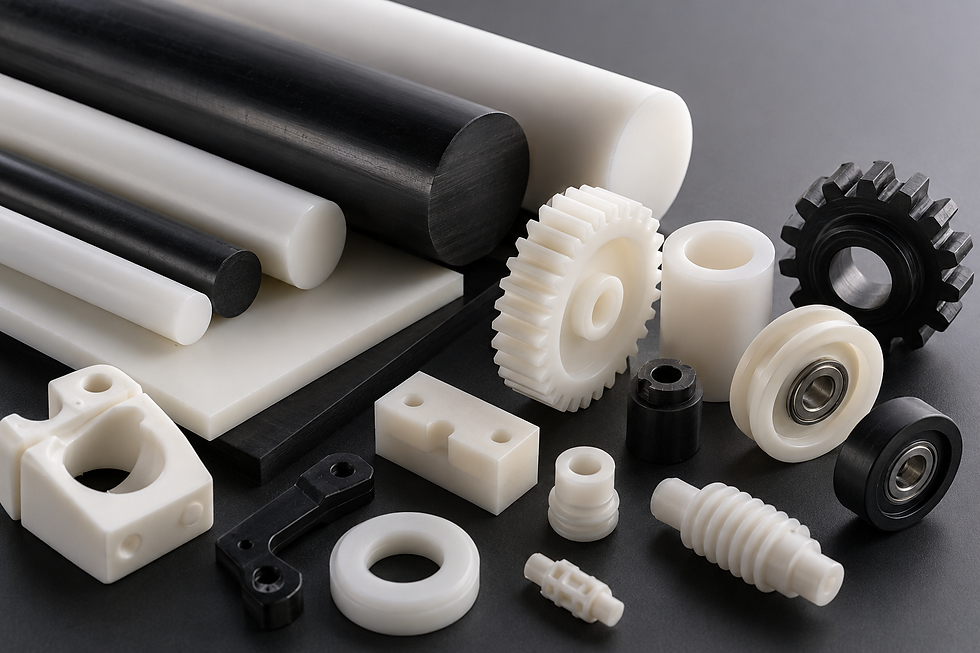
Common applications include:
Bearings and bushings
Gears and sprockets
Valve components
Rollers and conveyor parts
Food processing equipment
Pump and fluid handling components
Electrical insulators
Wear strips and guide rails
Delrin® vs Acetal: Understanding the Difference
One of the most common misconceptions in the plastics industry is that Delrin® and acetal are the same material.
While Delrin® is an acetal, not all acetals are Delrin®.
Delrin® is a homopolymer acetal (POM-H) manufactured by Delrin USA, LLC. Most acetal stock shapes sold today are produced from copolymer acetal (POM-C) resins supplied by major global resin manufacturers.
Common copolymer acetal resin brands include:
Celcon®
Ultraform®
Kepital®
Shape manufacturers also market acetal products under tradenames such as:
Acetron GP® (Mitsubishi Chemical Advanced Materials)
TECAFORM® (Ensinger)
Other proprietary extrusion grades
Although these materials appear similar and are often interchangeable, important differences exist between homopolymer and copolymer acetals.
Homopolymer Acetal (POM-H) vs Copolymer Acetal (POM-C)
Quick Comparison
Property | POM-H (Delrin®) | POM-C |
Strength | Higher | Slightly Lower |
Stiffness | Higher | Slightly Lower |
Heat Deflection Temperature | Higher | Lower |
Hot Water Resistance | Good | Better |
Steam Resistance | Good | Better |
Chemical Resistance | Excellent | Excellent |
Resistance to Chlorine and Alkalis | Good | Better |
Centerline Porosity | More Common | Less Common |
Food Processing Applications | Good | Often Preferred |
Mechanical Properties
Homopolymer acetal generally provides 10-15% higher strength and stiffness than comparable copolymer grades.
POM-H also offers a heat deflection temperature approximately 30°F higher than standard POM-C materials. These advantages make homopolymer acetal attractive for highly loaded machined components where maximum rigidity is required.
For many industrial applications, however, the performance difference is small enough that copolymer acetal remains the preferred choice.
Hot Water and Steam Resistance
One of the most important distinctions between the two acetal families is resistance to hydrolysis.
Hydrolysis occurs when prolonged exposure to hot water, steam, or aggressive cleaning cycles causes polymer degradation over time.
Copolymer acetal demonstrates superior resistance to:
Hot water
Steam cleaning
Repeated washdown cycles
High-humidity environments
As a result, POM-C is frequently selected for food processing, beverage equipment, and sanitary industrial applications.
Chemical Resistance
Both homopolymer and copolymer acetals offer excellent chemical resistance compared to many engineering plastics.
However, copolymer acetal generally performs better when exposed to:
Chlorine-containing solutions
Bleach-based cleaners
Strong alkaline cleaning chemicals
Food processing sanitizers
Because many food and beverage processing systems utilize these cleaning agents, copolymer acetal is often the safest and most durable choice.
Machinability
Acetal has earned a reputation as the machinist’s preferred engineering plastic.
Key machining benefits include:
Excellent chip formation
Minimal moisture absorption
Good dimensional stability
Low internal stress
Tight tolerance capability
Smooth surface finishes
Homopolymer acetal’s higher stiffness can provide slightly faster machining rates on screw machines and high-speed CNC lathes. However, both POM-H and POM-C are considered among the easiest engineering plastics to machine.
Centerline Porosity in Acetal Shapes
When machining acetal rod and plate, it is important to understand the possibility of centerline porosity.
During extrusion, microscopic voids may form near the center of larger stock shapes. These voids can range from approximately 100 to 150 microns in diameter.
Potential concerns include:
Reduced mechanical strength
Leakage paths in pressurized applications
Difficult-to-clean surfaces
Potential bacterial harborage areas
Copolymer acetal typically exhibits lower levels of centerline porosity than homopolymer grades, although both material families can exhibit some degree of microporosity depending on shape size and manufacturing conditions.
For critical sealing, sanitary, or pressure-containing applications, material selection should consider these factors during the design phase.
Common Acetal Grades
Approximately 80% of all acetal stock shapes are produced from unfilled copolymer acetal because it provides the best balance of strength, machinability, chemical resistance, dimensional stability, and cost.
Specialized grades are available to address specific performance requirements.
Standard Grades
POM-C (natural, black, and custom colors)
Delrin® 150 extrusion grade
Delrin® 511 molding grade
Wear and Bearing Grades
Delrin AF®
Delrin AF Blend®
W-Guard® internally lubricated grades
Turcite®-type bearing materials
UV Resistant Grades
Delrin® 527
Glass Reinforced Grades
Delrin® 570 (20% glass reinforced)
Static Dissipative Grades
R-Guard POM-C ESD (Warren PSI)
Semitron® ESD 225 (Mitsubishi Chemical Advanced Materials)
Why Acetal Remains One of the Most Popular Engineering Plastics
Few engineering plastics offer the versatility of acetal. It combines:
Excellent machinability
High strength and stiffness
Low moisture absorption
Good wear resistance
Excellent dimensional stability
Broad chemical resistance
Competitive cost
For many machined components, acetal represents the ideal balance between commodity plastics and higher-cost materials such as PEEK, PPS, PAI, and PPSU.
Whether specified as Delrin®, POM, Acetron GP®, TECAFORM®, or simply acetal, understanding the differences between homopolymer and copolymer grades helps ensure optimal performance and long-term reliability.
Warren Engineered Plastics manufactures and supplies extruded engineering plastic shapes ranging from commodity engineering materials to advanced high-performance polymers including Acetal, Nylon, UHMW, PPS, PPSU, PEEK, and other specialty materials used in demanding industrial applications.


Comments