

Understanding Nylon: The Original Engineering Plastic
What Is Nylon?
Few materials have had a greater impact on modern manufacturing than nylon. First commercialized in the late 1930s, nylon became the world’s first successful engineering thermoplastic and helped launch the modern plastics industry.
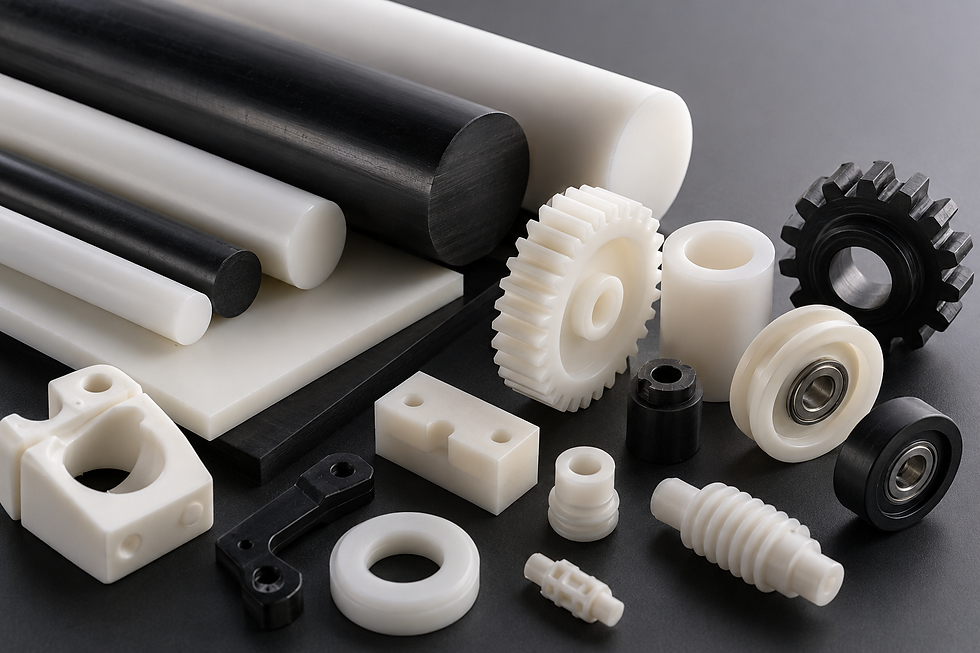
Today, nylon remains one of the most widely used engineering plastics for machined components because it combines toughness, wear resistance, strength, machinability, and cost-effectiveness in a single material. Whether used in bearings, bushings, rollers, gears, wear pads, or electrical insulators, nylon continues to solve demanding engineering challenges more than 80 years after its introduction.
For manufacturers of extruded plastic shapes, nylon remains one of the most important materials processed into rod, plate, tube, and custom profiles.

The History of Nylon
Nylon was invented by Wallace H. Carothers and his research team at DuPont during the 1930s. Their goal was to develop a synthetic replacement for silk, which was widely used in textiles and women’s hosiery.
The outbreak of World War II accelerated nylon’s adoption as production shifted toward military applications including:
Parachutes
Tire reinforcement
Ropes and webbing
Military fabrics
Protective equipment
Following the war, engineers quickly recognized that nylon offered much more than textile performance. Its combination of toughness, wear resistance, and mechanical strength made it attractive for industrial and mechanical applications.
By the late 1940s, nylon had become one of the first plastics routinely machined into finished components.
Nylon and the Birth of the Plastic Shapes Industry
The machinable plastics industry owes much of its existence to nylon.
In 1946, The Polymer Corporation began extruding nylon rod and plate from DuPont resin for industrial machining applications. Those early products helped establish what would become today’s plastic shapes industry.
The concept was simple but revolutionary: produce stock shapes that could be machined into finished components using conventional metalworking equipment.
That approach remains largely unchanged today. Companies such as WarrenPSI continue to convert engineering and high-performance thermoplastics into shapes that are machined into critical components across countless industries.
Why Engineers Choose Nylon
Despite the introduction of newer engineering plastics such as Acetal, PPS, PPSU, and PEEK, nylon remains one of the most frequently specified materials for industrial applications.
Key benefits include:
Excellent toughness
High impact resistance
Outstanding wear resistance
Good fatigue performance
Low coefficient of friction
High load-bearing capability
Excellent machinability
Competitive cost
These characteristics make nylon particularly effective in applications involving repeated motion, sliding contact, impact loading, and abrasive environments.
Common Applications for Nylon
Nylon is frequently specified for:
Bushings
Bearings
Wear pads
Rollers
Gears
Sheaves and pulleys
Valve seats
Conveyor components
Electrical insulators
Structural machine components
In many applications, nylon provides significant weight reduction, corrosion resistance, and noise reduction compared to metal alternatives.
Nylon 6 vs Nylon 6/6
The vast majority of nylon stock shapes are produced from either Nylon 6 or Nylon 6/6.
Although closely related, these materials offer distinct performance characteristics.
Nylon 6/6
Nylon 6/6 was the original DuPont nylon chemistry and remains one of the most widely used engineering plastics.
Key characteristics include:
Higher strength
Higher stiffness
Better heat resistance
Good wear performance
Excellent machinability
Nylon 6/6 is commonly used when structural strength and elevated-temperature performance are important design considerations.
Nylon 6
Nylon 6 was developed as an alternative chemistry that could be polymerized directly from caprolactam.
Key characteristics include:
Superior toughness
Better impact resistance
Lower internal stress
Larger available shape sizes
Excellent wear properties
Most cast nylon products are based on Nylon 6 chemistry.
What Do the Nylon Numbers Mean?
The numbers associated with nylon grades refer to the number of carbon atoms present in the polymer’s building blocks.
For example, Nylon 6/6 is produced from:
Hexamethylenediamine (6 carbon atoms)
Adipic acid (6 carbon atoms)
The resulting polymer is technically called poly(hexamethylene adipamide), but the simpler designation “Nylon 6/6” quickly became the industry standard.
Other common nylon families include:
Nylon Grade | Primary Benefit |
Nylon 6 | Toughness and castability |
Nylon 6/6 | Strength and heat resistance |
Nylon 11 | Low moisture absorption |
Nylon 12 | Low moisture absorption and flexibility |
Nylon 6/12 | Balanced mechanical performance |
Nylon 4/6 | Enhanced strength and temperature capability |
Cast Nylon vs Extruded Nylon
Within the plastic shapes industry, nylon products are often categorized as either cast nylon or extruded nylon.
Cast Nylon
Cast nylon is produced by polymerizing liquid caprolactam directly into molds.
Advantages include:
Large shape sizes
Excellent toughness
Low internal stress
Superior wear resistance
Ability to incorporate additives during casting
Extruded Nylon
Extruded nylon is manufactured using conventional thermoplastic processing equipment.
Advantages include:
Consistent dimensions
Excellent surface finish
Efficient production of smaller profiles
Broad material availability
Competitive cost
Both forms are widely used and can provide excellent performance when properly matched to the application.
Moisture Absorption: Nylon’s Most Important Design Consideration
One characteristic separates nylon from many other engineering plastics: moisture absorption.
Nylon naturally absorbs moisture from its environment. While this often improves impact resistance and toughness, it can also influence:
Dimensional stability
Mechanical properties
Tolerances
Long-term performance
For applications requiring extremely tight tolerances or minimal moisture uptake, materials such as Acetal (POM), PPS, or PEEK may offer advantages.
Understanding the operating environment is critical when selecting nylon for precision applications.
Specialty Nylon Grades
Modern nylon technology extends far beyond standard Nylon 6 and Nylon 6/6.
Specialty grades include:
Glass-Filled Nylon
Improves stiffness, strength, and dimensional stability.
Carbon Fiber Reinforced Nylon
Provides enhanced rigidity and reduced thermal expansion.
Internally Lubricated Nylon
Designed for wear-intensive applications requiring reduced friction.
Impact-Modified Nylon
Offers improved toughness under shock loading.
High-Temperature Nylon
Products such as HTN and Nylon 4/6 provide improved thermal performance.
Nylon 11 and Nylon 12
These specialty nylons absorb significantly less moisture than conventional nylon grades and are often selected for demanding fluid-handling, automotive, and industrial applications.
Why Nylon Remains Relevant in the Age of High-Performance Plastics
While advanced materials such as PEEK, PPSU, PPS, and PAI continue to expand the capabilities of engineering plastics, nylon remains one of the best value materials available.
Its combination of:
Toughness
Wear resistance
Mechanical strength
Machinability
Broad availability
Cost effectiveness
More than eighty years after its invention, the original engineering plastic continues to earn its place in modern machinery, industrial equipment, transportation systems, and manufactured products around the world.
At WarrenPSI, nylon remains a core material family produced alongside Acetal, UHMW, PPS, PPSU, PEEK, and other engineering and high-performance thermoplastics. Whether the requirement is standard Nylon 6/6, cast nylon, internally lubricated grades, or specialty reinforced formulations, selecting the proper nylon grade remains one of the most effective ways to balance performance and cost in a machined plastic component.


Comments